

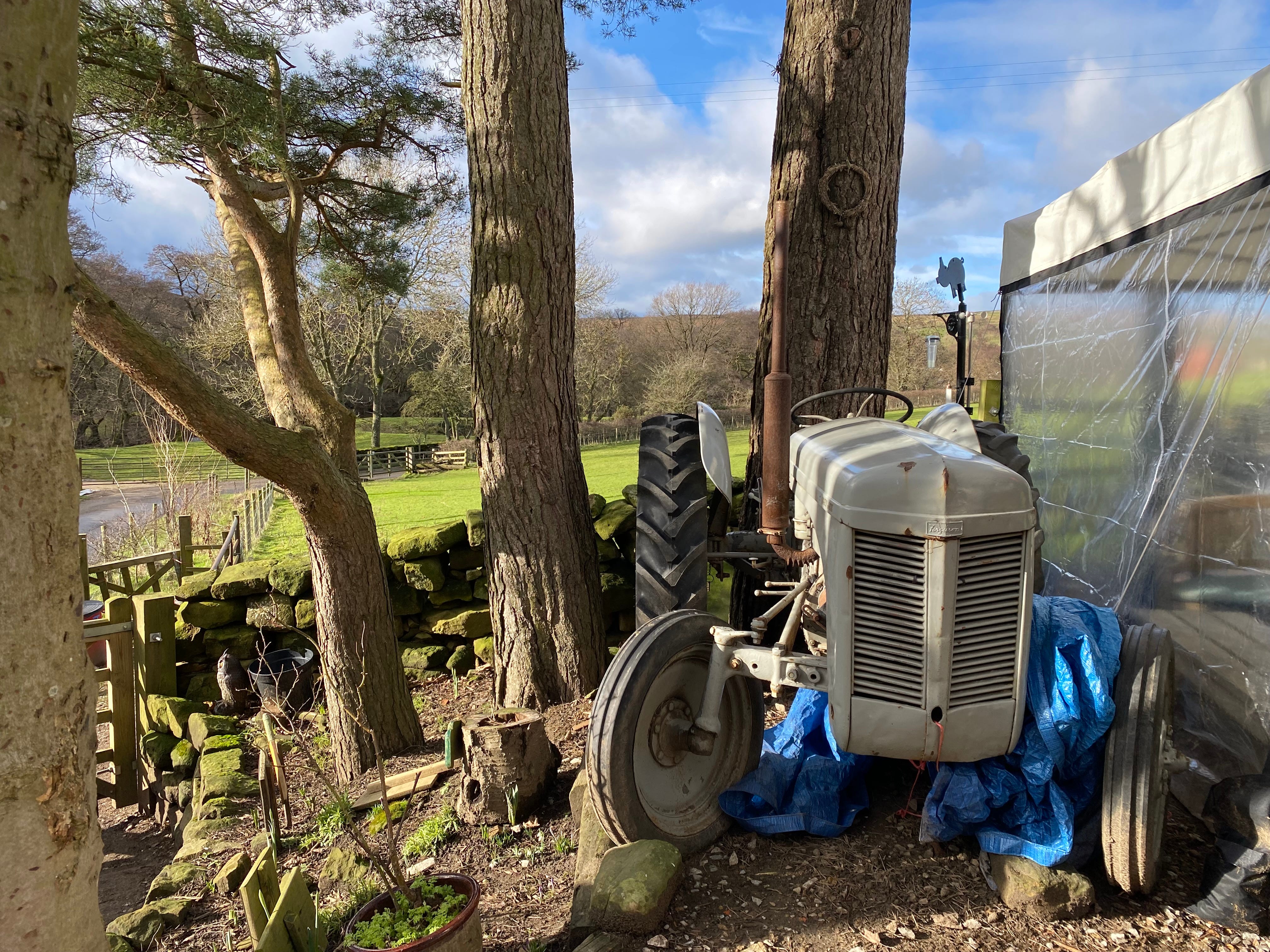
This age-old Massey-Ferguson tractor is now a show-piece outside an outward bounds centre for kids with disabilities, where a credo of challenging boundaries through love is embraced. The engine’s been maintained and still runs true, at the turn of a crank-handle.
These Childish Things - Pt3.
“Tools for the Job.”
The antiquated tractor that collected us outside the Bluebell Inn, at 5.30am on the dot, had seen better days; but the engine purred powerfully, as if brand new. Something similar could also be said of its driver, who, despite his years and shrivelled appearance, was spright enough to swing the old Massey-Ferguson, trailer-cum-charabanc in tow, deftly round in a tight half-circle, and followed it with a perfectly performed three-point turn. Leaving the engine running, he jumped nimbly down by the bus stop, on the corner of what had once been a bustling WWI and WWII Army camp, bristling with heavy coastal batteries, now a caravan site frequented by Yorkshire folk, mostly from Hull. Everybody who was anybody was there, young and old alike, huddled together in tight-knit family or social groups, making small-talk, whilst clasping woolly collars on end-of-the-line knitwear to their throats, in a vain attempt to keep out the biting cold. The wind, gusting directly up the lane, off the cold North Sea, was bitter.
Conversation was minimal, as a consequence, and primarily restricted to the elder stateswomen among us, camp tittle-tattle for the most part, the atmosphere far too tense and the night air way too cold for cogent discourse. The Bluebell Inn, painted a sickly pallid blue by the current incumbent, and now doubling as the corner shop, looked cheerless in the flickering half-light afforded by a single, faulty bulb, slung loosely between two telegraph poles on the edge of camp. It clacked eerily on its moorings, jostled to and fro by howling gusts that gave the whole ensemble a Gothic Hammer-movie feel, face and forms strobed by manufactured lightning. The village churchyard, just along the lane, added further to the atmosphere, a creeping phantasmic undercurrent reminding us of our own mortality. It was not lost on any one. A plaque, mounted above the entrance to the shop, read: “Built in 1847, five hundred and thirty-four yards from the sea”. It was now nearer one hundred and fifty, by my reckoning, and getting closer every passing year.
“There’s an old Saxon village, two miles out to sea.”
“Aye, an’ thee can still ’ear t’ church bell ring, an’ all, at low water.”
“Don’t talk wet!”
“Ah tell thee, yer can; ah’ve ‘erd it several times, missen!”
“Rubbish!”
“It’s true! Ah’ve erd it n’ all. Swear on mi mother’s grave!”
“Yer talkin’ cobblers!”
“It’s thee talkin’ cobblers!”
“It’s true enough! T’ bell rang just last week, when we ’ad that bad storm. Din’t yer ’ear it? Clear as a bell, it wor.”
“Go on! Pull t’ other one!”
Everybody got the joke and laughed and, tone set, climbed eagerly aboard the trailer. I don’t know whether it was the promised reward of a ten-bob note that attracted us from our warm beds, on a crisp and freezing early October morn, or the machismo of a day in the sticks, hand-in-hand with the camaraderie long-associated with the working-class and recent war-effort - both probably. We sat on makeshift wooden benches, bolted along each side of the trailer’s side-rails, facing in towards one another, eyes glinting in the twilight, smiles fixed and relaxed.
The journey across the thick neck of the peninsula to Patrington remains a blur. In the dark, all I remember is it was fast; far faster than my dad did it in his Wolsey. The trailer had pneumatic tyres, but the road was pitted with deep potholes and so, accordingly, we were tossed from pillar to post, as the skinny little man threw the tractor with practiced aplomb around the wickedly sharp corners and u-bends, typical of East Yorkshire. His seat was well-sprung and he bounced comically up and down, from one divot to the next, the over-sized steering wheel in his lap acting as an anchor. It was cold and dark and damp when we set off, and no different when we arrived in the farmer’s field, predawn. We reformed in a tight huddle, blowing warmth into cupped hands, eager for the task ahead. It was potato-picking season.
Went the day well?
We all lined up in our assigned stations around said large family groups, and began to lift the tubers as they were turned over mechanically by the tractor, several rows at a time, into individual handheld plastic baskets. Then we transferred them, easy by the stone, into paper sacks labelled: ‘Specially selected potatoes’. They smelled wonderfully of rich, wet earth. The Kilnsea brigade, of which I was part, was located high up, at the top end of the sloping field, and various other workers, whom I’d not originally noticed in the dark, lower down. This was a massive concern, with other fields planted with ridged potatoes visible through gaps in the hedges, nearby, all waiting to be dealt with as the weather did allow. At first, things went well. There was time enough for a joke or two along the way, and a flask of tea, mid-morning, with biscuits and then an apple-pie provided by the farmer’s wife. As the day wore on, the farmer suddenly jumped from his tractor and, hands on hips, asked politely for two volunteers.
“Would two o’ thee like to work yon end o’ t’ field. It’s nowt burra short plot. Cum on; worr about it? Let’s be ’avin’ thee!”
Nobody moved a muscle. Suddenly, the elderly matriarchs among us were more interested in the broken worms, wriggling about in the freshly turned soil and ogling their muddy boots, brushing one against the other to remove bits of dried-on clart, mute. Their sheepish children followed suit and, eyes firmly to the ground, matched perfectly their parents’ performance, nuance for nuance. The farmer upped the ante and began pleading with us and, instead of making generalities, turned to address the bloc of children in our group.
“Please, just two o’ thee is all ah want. It’ll be reet, don’t wurry. Cum on lads!”
It was at that point, I took pity on him. A grown man reduced to begging was something I wasn’t used to seeing and, never one to hold back or consider the consequences of my actions, volunteered myself and my mate Gary for the job. Anyway, the idea of branching out on my own, now I was I the swing of things, really did appeal to me.
“Come on Gary, it’ll be good.”
Gary, one of three lads from Hull I knocked about Spurn with, almost swooned on the spot and, over-elongated tongue hanging limp outside his mouth, as was his habit, and with a very pained expression on his face, looked to his mum for a method of escape. She couldn’t help. He had been granted a label, gratis, by me and the farmer was running out of patience, fast. He dropped the polite.
“Reet! Ge’ thissens darn to t’ row at bottom o’ t’ field. Cum on! Be sharp! Ay ‘an’t gorrall day!”
He wasn’t pleading with us anymore and gesticulated with a thin bony finger, through the throng of workers, to the far end of the potato patch, a good way off. So, having been given our marching orders by the farmer, who was already back in the tractor and revving up the engine, we scurried as fast as we could to the assigned plot, only to discover that we’d been duped. It was way too long for two people to manage. Four fit adults would have been more like it; and from the very outset, it was obvious I had bitten off more than Gary and I could chew. So far, the work had been hard, but manageable and fun. Now, it became unremittingly impossible. No way on God’s earth could we keep pace with the hideous tractor’s progress up and down the knot of workers, turning out tubers from the furrows at a rate that defied all our efforts to please said manic little farmer.
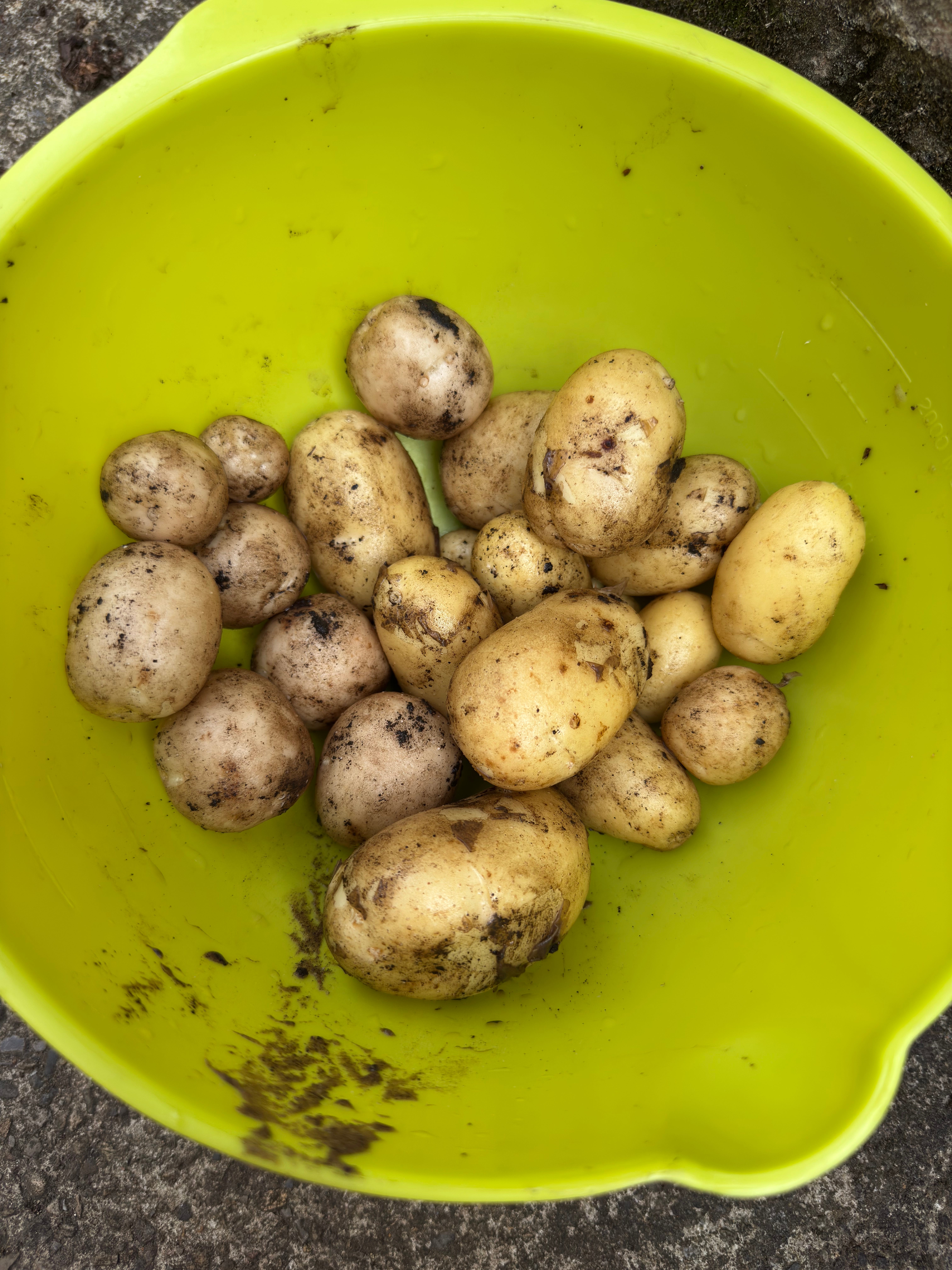
Working as hard as we might, scrabbling about in the clart like fevered jackals round a kill, we never once were ready, when he returned to turn over the next few rows of spuds. It was doubly embarrassing, because he made a public spectacle of us at every given opportunity, stopping the tractor and jumping theatrically down from his seat to wag his finger - later in the day, clenched fists - as he gave us what for, at the top of his voice, so that everyone could hear.
“Wot the ‘ell’s up wi’ thee? Gerra b*£%* move on, yer lazy little so-and-so’s! Cum on, else thee’s no’ gunna gerra penny off me, tonight!”
There was no doubting that he meant it. Gary never spoke to me, again. At the end of a day, I thought would never come, the farmer called time. I collapsed onto the soil and Gary ran sobbing to his mam. The sun was setting, as we all lined up at a makeshift bench erected on trestles, in the exit to the field, where the farmer and his wife sat dignified and upright, ready to dole out cash. I ached in every muscle and bone in my body, and tears were not very far away. Gary and I detached ourselves from the others and stood coyly at the back of the queue; and with good reason. It looked as though the farmer was as good as his word. He began grilling each recipient, in turn:
“Thee’s no’ one o’ yem two as wos workin’ t’ end row is thee?”
“No!” Each responded, indignantly - perish the thought!
I couldn’t believe what was playing out. You’d have thought, by then, he might have recognised our faces, without the Spanish inquisition. Or was he deliberately rubbing our faces in the shame of our inability to measure up to scratch, an elaborate form of mental torture, much akin to his petulant performance throughout the day? In retrospect, I think he was a horrid little bully, and probably the victim of bullies all his life, due to his own short stature. When, eventually, we did present ourselves to get our pay, last in line, he’d long since given up asking. Not a single word was spoken during the transaction, which strangely held all the piety and sombreness of a funeral service; a Yorkshireman parting with his brass. I wanted so much to crack him one on the jaw, even though he’d have murdered me for it, one hand tied behind his back. It took me aback, because we were taught to respect our elders, from a very early age, irrespective of circumstances; and clouts to the lughole were a punishment reserved for wayward children, not farmers.
I shoved the manky, moth-eaten ten-bob note into my jeans pocket, without any of the anticipated thrill of having ‘joined the ranks’, and shuffled painfully into my place on the back of the trailer. I should have felt wonderful, with ten shillings to spend exactly as I wanted. I didn’t. The skin of my fingertips had worn as smooth as alabaster, and blisters on the palms of my hands and soles of my feet had long-since burst. Blood mingled in the ingrained dirt. Would that blisters were my only problem! The seams of my jeans had chafed away neat rings of skin around my waist and groins and the backs of my knees - and the tops of my Wellington boots had systematically done the same to my lower legs, so that sitting down, clenched by denim and latex on the trailer, was absolute agony. I wasn’t coming back in the morning to work for this brute, not for all the tea in China.
Night was falling, fast. In my chagrin, I blurted out:
“Balls to ‘im!”
But, my remonstrations fell on deaf ears. No-one was remotely interested in my plight or indignation. Instead, their faces shone with pride, and their talk was of the morrow’s outing to pick the field next-door. For my part, I never wished to see another potato again, as long as I lived. I meant it, though like many things around that time and long-since, I hadn’t thought it through. Guess what was for dinner, when I finally got in the caravan that evening? Mince, peas, gravy and, of course, ‘specially selected’ local potatoes.
Lovely writing
Very good 👍