

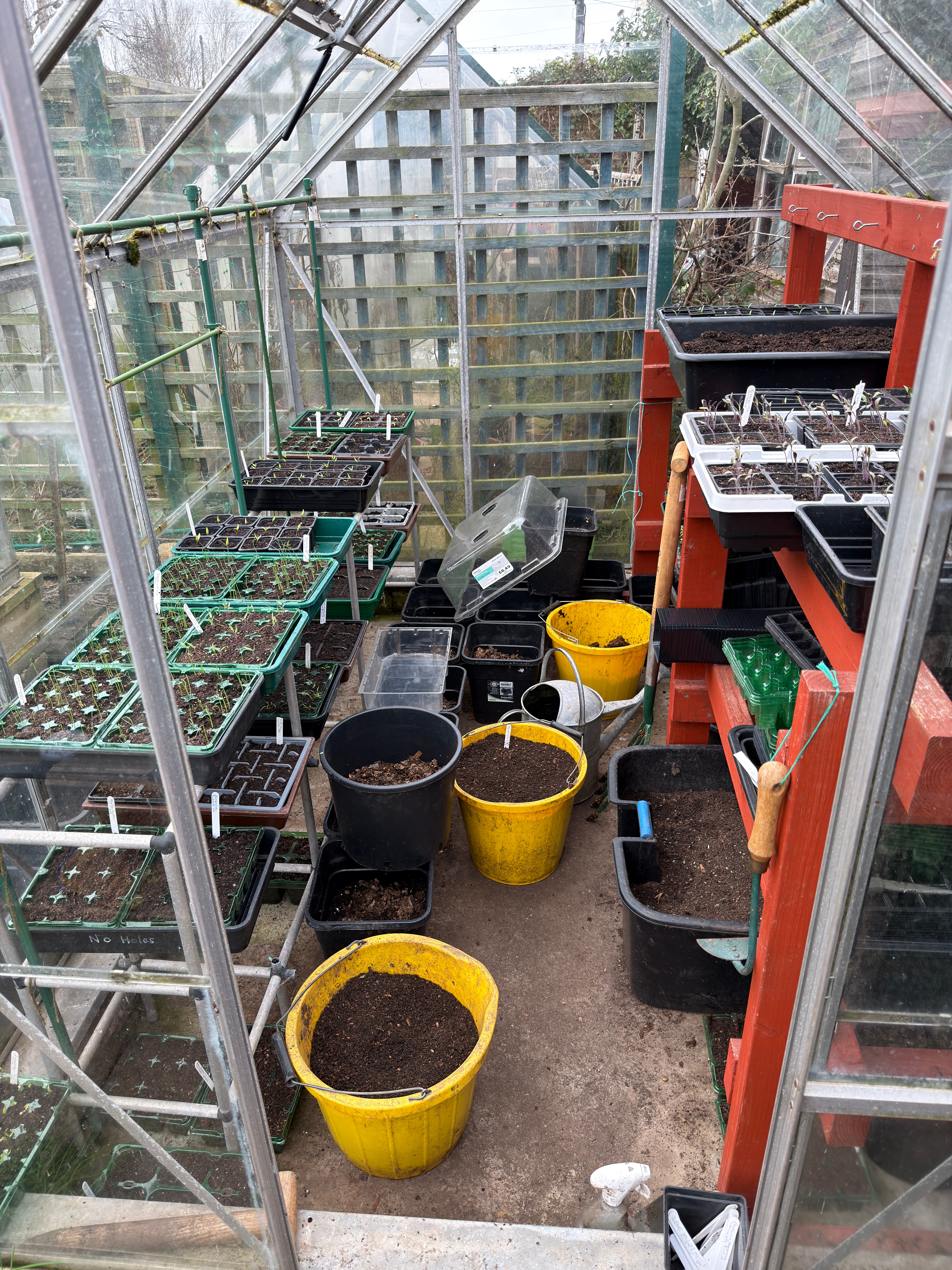
Above: A peek into my 8’x6’ greenhouse this March, order restored after what could have been a total disaster: a duff bag of Singleton’s compost (waterlogged) and a failed raft of precious early sowings, across the board. New and healthy seedlings on the left and dead and dying on the right.
Clutter-bug.
A glimpse inside my greenhouse at the beginning of any season, or come to that, over our back-fence, will quickly tell you that I’m either a very tidy, competent gardener, or a complete and utter mess, depending on the hour. Everything on the plot, in Spring, is in a rapid state of flux. It has to be; with only 365 square feet of space to play with and a lot of crops to raise and fit in over the course of a year, I have no choice but to accommodate, in as patient a way possible, endless trays of seedlings, piles of manure, buckets of homemade compost, sieved leaf-mould, and on top of all that, recyclable green-waste heading for the compost-bins or wormery, in one long nose-to-tail convoy - all without losing sight of the goal, the pleasure factor.
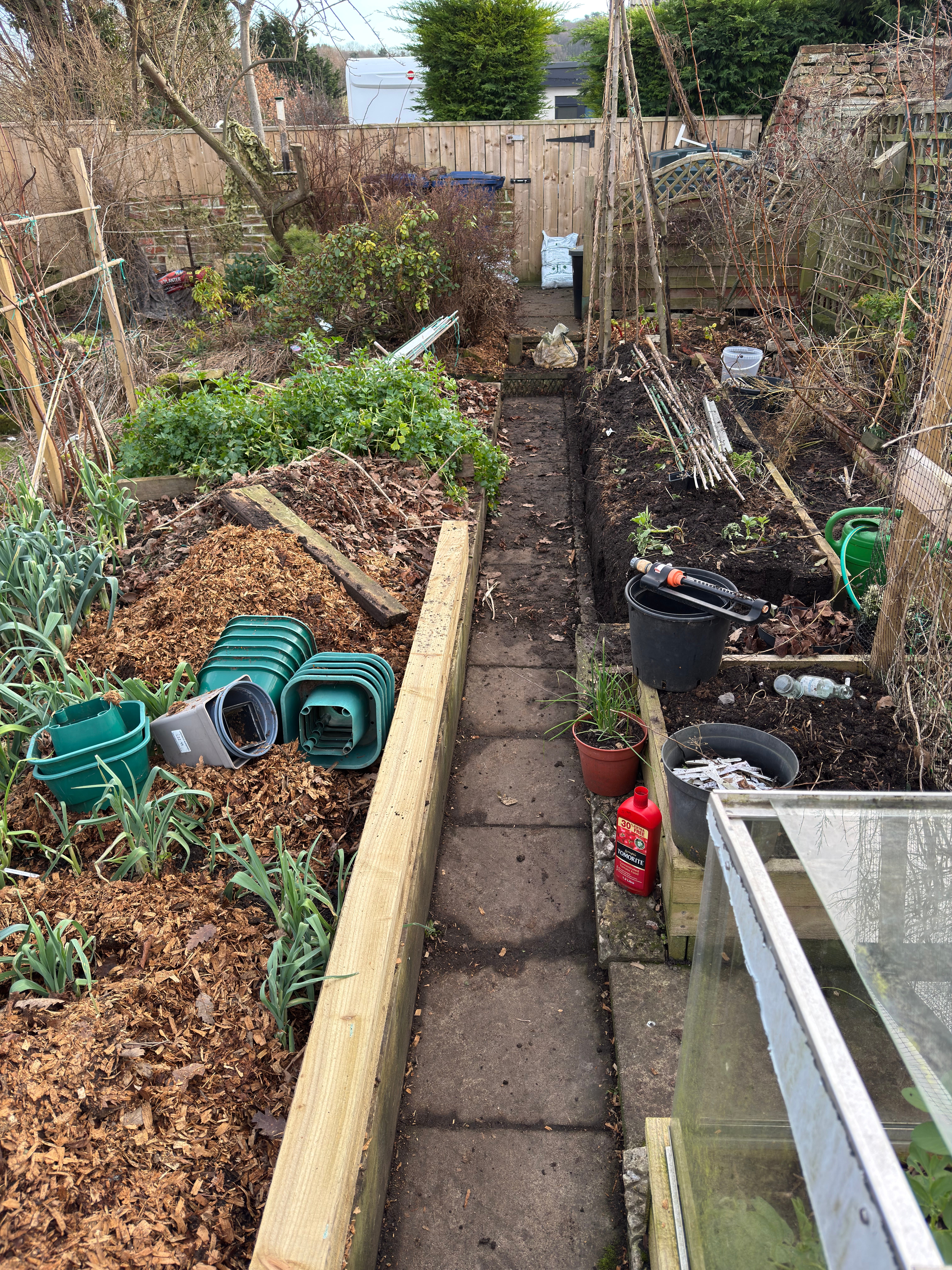
Above: This was my plot in Spring, last year. Believe it or not, this was tidy by my standards and the culmination of a lot of hard work, even before the growing season began.
Patience is a virtue.
Interesting choice of words here, and unintended when I set out writing this article, after what turned into an overlong seven hour stint on the plot that left me aching top to toe. Why? Because, for once, I didn’t go at it ‘hell for leather’ or ‘like a bull in a China shop’, and I’m feeling that familiar, cosseting release, long associated with homing in on the final straight, during what has been yet another marathon effort.
From this mess in February:
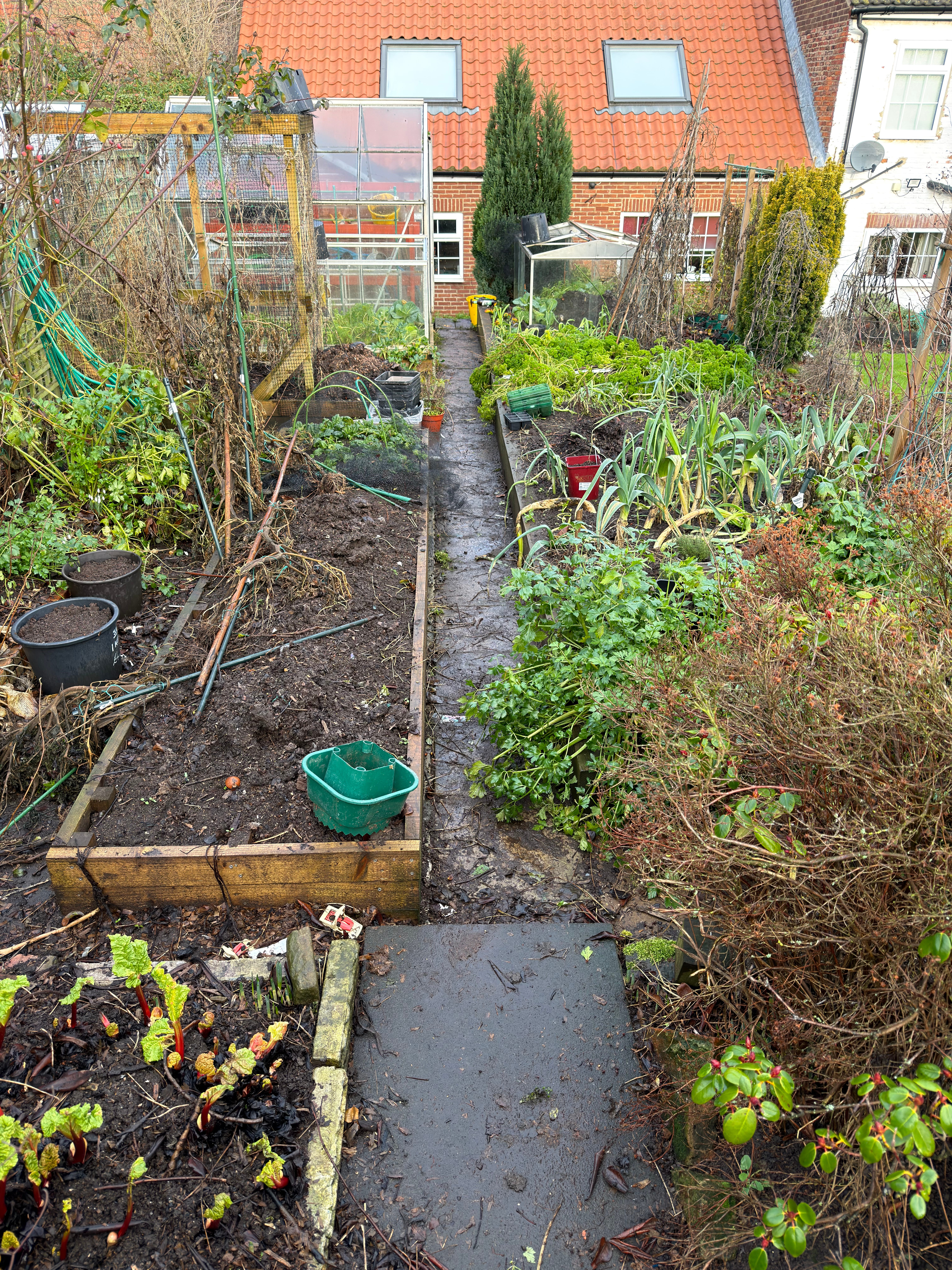
To this in March:
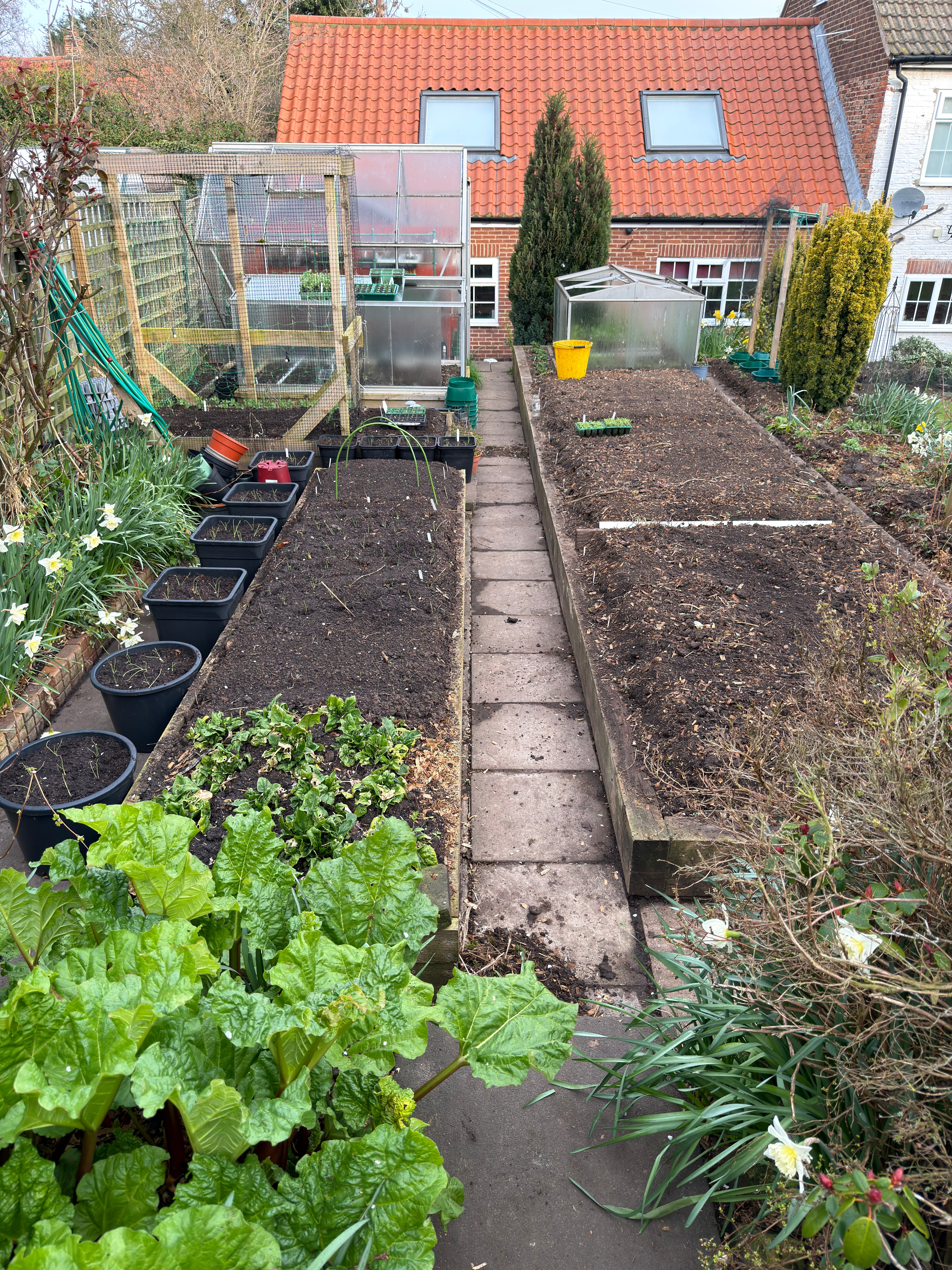
Above: These are my main-breaks on the last week of March, all double-dug and planted up, and with 10 of our 54 onion pots visible down the left hand-side. These six have Matelot shallots in, raised from seed by the fire and then hardened off outside. Once they are acclimated, they’re completely hardy and come July, they will have bulbed up nicely, with a beautiful pink blush running right through to their centre. They’re delicious, too, and pickle better than any onion!
Pacing myself.
The hours I keep throughout March, the push to sow a myriad seeds and whip the place into shape, are long, but properly paced according to my age. When I tended four allotments, and worked full-time as a doctor, I’d burn the candle at both ends, prepping deep-beds between surgeries, double-digging cow-muck two-spits down, just for the fun of it, often ‘till the cows came home’, as the saying goes, whilst the sun set orange-red on the distant horizon; and I loved it. I considered it more therapy than task, a break away from patients that was my time and mine alone. The camaraderie of fellow gardening enthusiasts, their topical banter and support was inspiring, the birdsong soporific, and the strengthening summer UV-rays like a balm. But, it was back-breaking work. I’d end up shifting tons and tons of manure from three of my muck-heaps, thinking myself invulnerable, and then pay for it later in the day and, subsequently, later on in life. Add in night-fishing sessions, humping heavy gear for miles along the shoreline or riverbank, and you can see why, on some mornings, I was totally knackered. I now live with sciatica; and I guess that’s the point I’m trying to make. The human frame can only take so much. Hence, I tend my kitchen plot with an entirely different attitude, today: ‘slow and steady wins the race’ - and for a very different kind of therapy, too, now that I’m retired: physiotherapy - and it really does work. I can attest to the fact that stronger back muscles do give significantly more support to worn vertebrae and, in so doing, help stop nipping of the sciatic nerve, thereby reducing background pain and spasm. I highly recommend it.
Tidy ship.
My dad was an inveterate sweeper. He liked things, ‘ship-shape and Bristol fashion’. I never got it. Summer days, when we kids were all lolling about with a fizzy drink or ice-cream to hand, wishing there was a cloud in the sky for brief respite from the heat and glare of the sun, he’d suddenly spring from his chair, pick up the yard-brush and start sweeping the paths. It was irritating. Dust apart, why would you? But he did, and even years later, when I was married with children, he’d have a broom to hand when I came home from work, and he’d give me ‘a look’ - that look that asked the same tired question, “why aren’t you doing this, yourself?” And I’d give him a look, which said something unrepeatable.
Now I’m of an age, the same age he was, I do a lot of things he did, like pick my teeth, front and back, with the tip of my tongue after a tasty meal, an irritating habit. I also rankle the bristles on my chin prior to a shave, and pull weird faces in the mirror to expose whiskers in hard-to-reach places; and I sharpen my pencils to a pristine point, I suspect because I watched in awe him doing it with a razorblade. And when the sun beats down, whatever the time of year, I pick up a yard-brush and sweep the garden paths, without a second thought. I do it, now, because it’s easier than not; plus, when they’re wet, they get as slick as ice and can be absolutely lethal. Many a time, especially when I’m dog-tired, I’ve come a right cropper traipsing through mud on our garden paths, spade or seed-trays in hand; and Christopher Deane, I am not! Regardless of which, I have to admit that I find uncluttered paths aesthetically pleasing, like my dad must have. So, it turns out, does my wife.
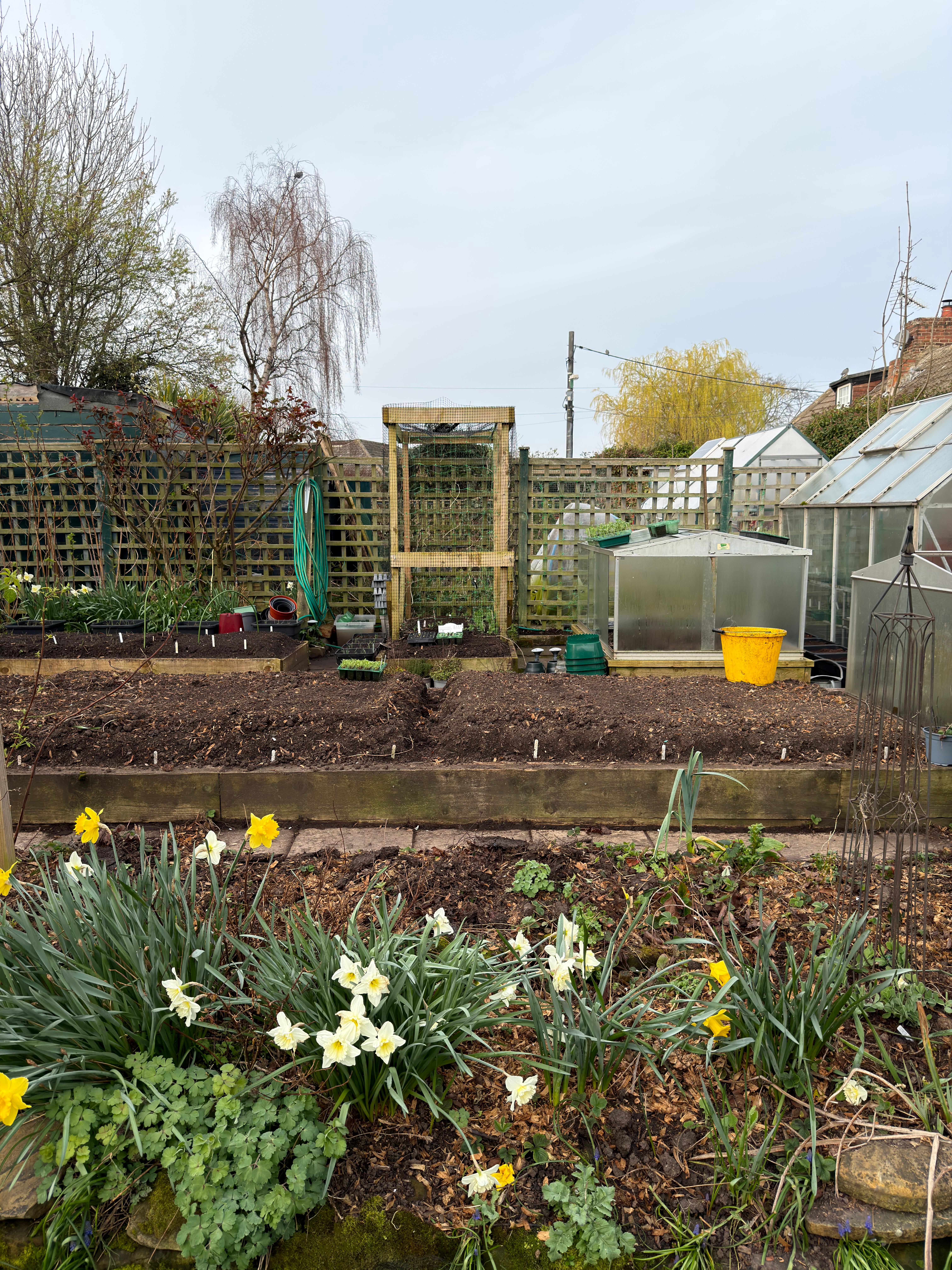
Above: This year’s potato breaks, side-on in spring; 4 tubers to a 5’ row, 4 rows to a 7’ break, 3 breaks in total. When the flags, separating allotment from flowers, start showing through mud churned up by the blackbirds, and the daffodils are in bloom, I know I’m winning the race and it’s downhill all the way from now on.
No secrets… There’s something in this photo that has completely transformed life on the plot, an innovation new to me this year. Clue: it’s very near the hosepipe. I’ll tell you at the end.
Rank and file.
Somewhere in a dark recess of my mind, I have a memory of a nursery rhyme book with a ditty in it called, “Ten Tin Soldiers”, something about them standing neatly in a row. It has particular relevance, when tending a small kitchen plot, not just because of the geometry I use in close-planting in figures of five to boost yields, but also because it maximises use of space in a modest but busy greenhouse, where it’s essential to make full use of every single available inch. I can’t afford to have trays or modules lying around in loose formation. So, there’s a fit for everything, even pencils.
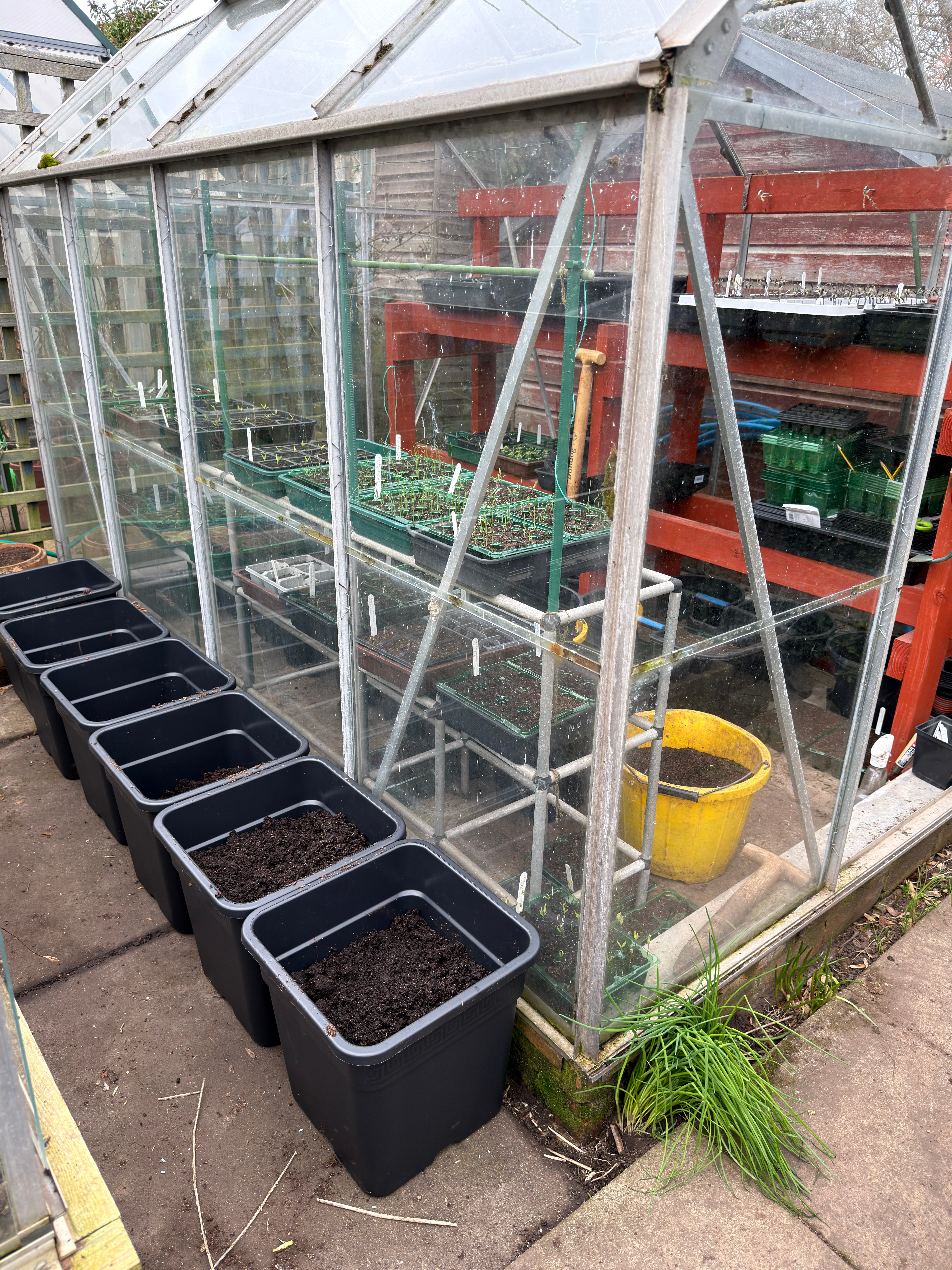
Above: Six newly acquired square pots for growing yet more onions in; a beautiful fit!
When I built my pine tomato support (see photo above), that doubles as a sowing station, attention to detail and tray width meant I was able to maximise staging usage, and still arrange my tomato and cucumber planters underneath in late-April, ready to accept the seedlings, once big enough to handle.
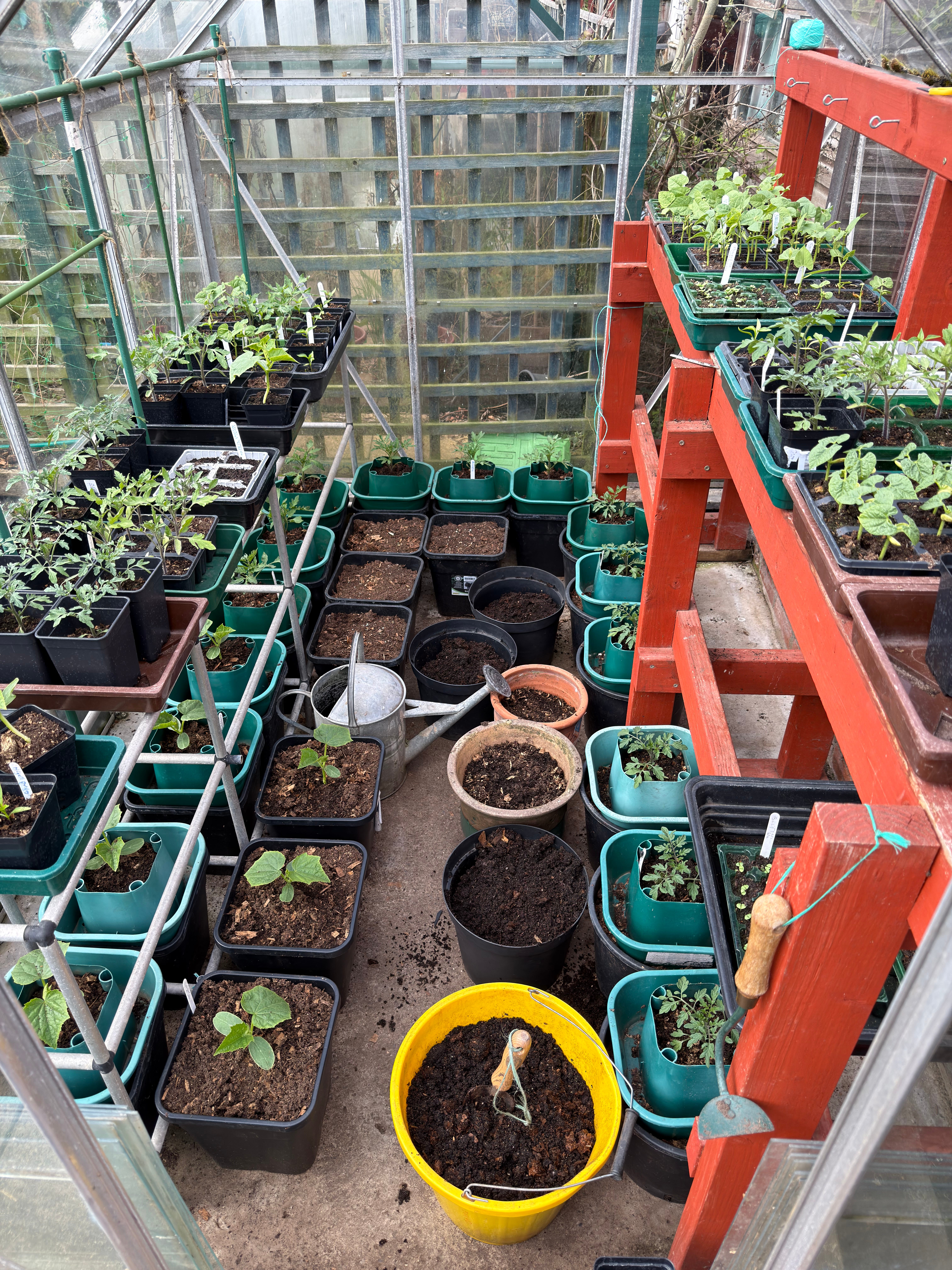
Above: The greenhouse on the 20th April. All done bar the shouting. The trays of seedlings on top are for outdoor planting and giving away to friends and neighbours.
Whilst potting-on my young tomatoes and chillies last year, and arranging the 3” pots cheek-by-jowl on trays, like ten tin soldiers, it occurred to me that square pots would be way more efficient than round. For a start, there’s less water slopping around and falling between gaps; but there’s also a pinch more compost for seedlings to grow into per capita. So, last month, I invested in 200 square pots of various sizes, from “Greenhouse Essentials”, a great family-run service, selling excellent quality products, very competitively priced.
Whilst on the subject of geometry, if you’re using deep-beds like me, you can plant one-third closer together, in figures of five, as recommended by John Seymour in his excellent book, “The Self-sufficient Gardner” 1978 edition. It helps boost yields by 2-3x per unit area; and if you have successional crops ready to go in, once your summer spread is finished, and your soil is rich, you can replant with autumn and winter-hardy varieties straight after, using the same principle, and enjoy fresh veg all the year round. I can vouch for the fact that it works; and it’s a massive boon when using a 6’x4’ cold-frame, where efficient use of space is crucial to getting the best out of it.
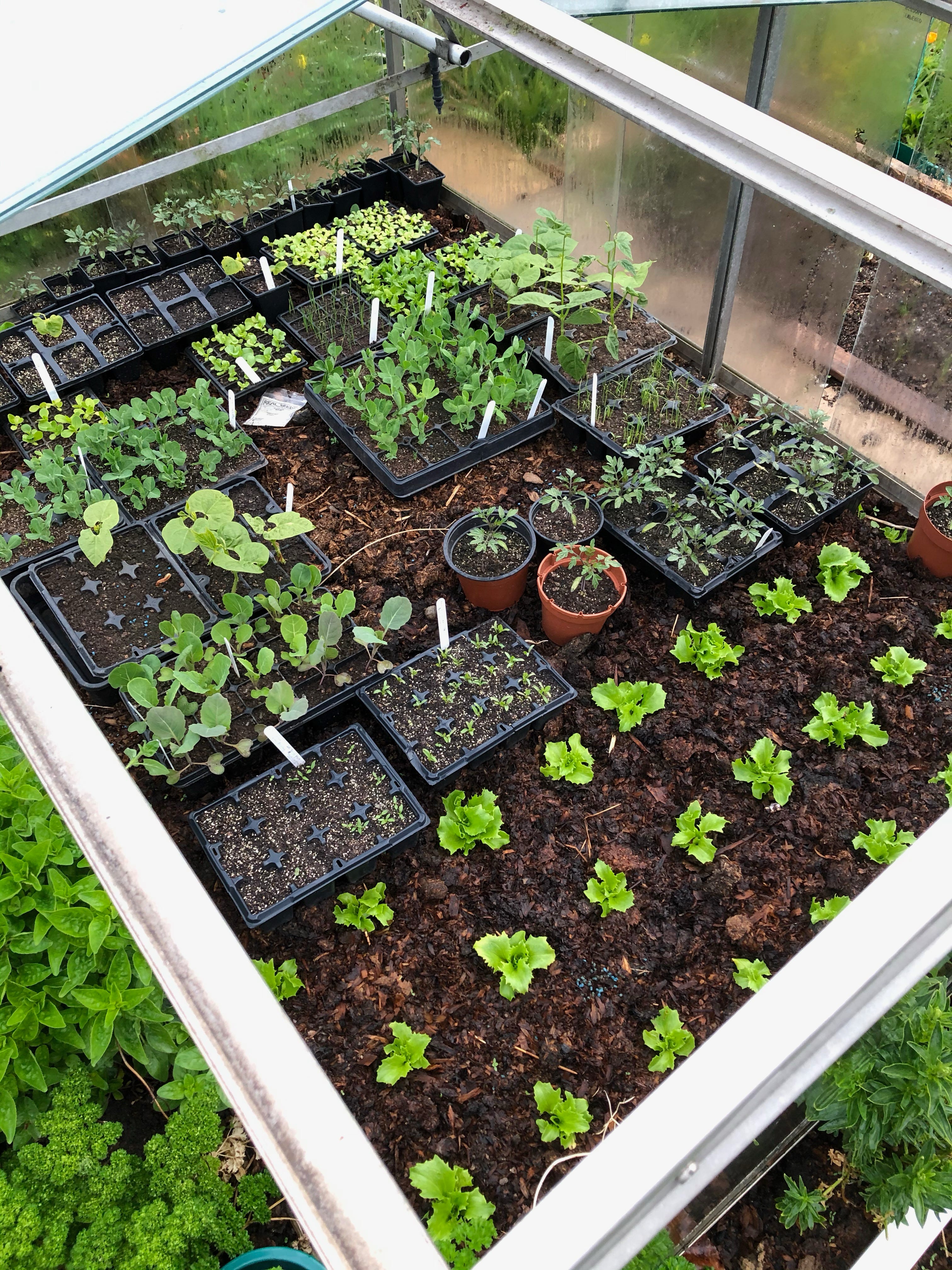
Above: A good shot of one of my two cold-frames in April ’22, doubling as halfway house and hardening-off post for lots of my greenhouse seedlings, before moving them on into permanent beds. A week after this photo was taken, it was emptied and fully planted up with beetroot, miniature cabbages, French beans and various salad crops. By July, most had been harvested and eaten. I then replanted with winter-hardy varieties like main-crop carrots, spinach and broad beans. The carrots were fantastic!
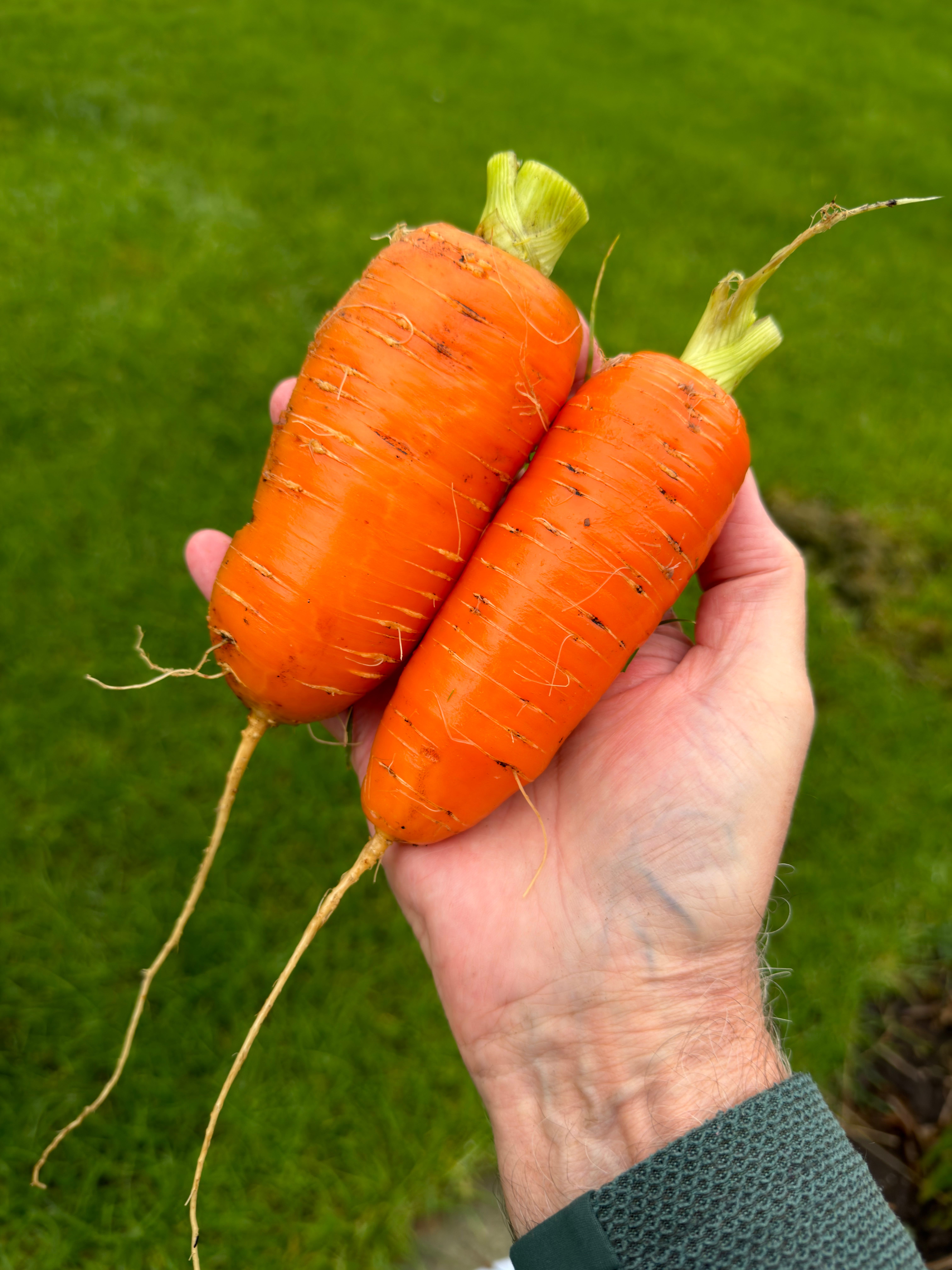
Tip: I sow my carrots reasonably thinly, but I never thin them out. The soil, once upon a time heavy clay, is now so loose and well-fed that they nudge one another aside and grow perfectly formed. These are two carrots from that same cold-frame, harvested this February:
The Plot this May.
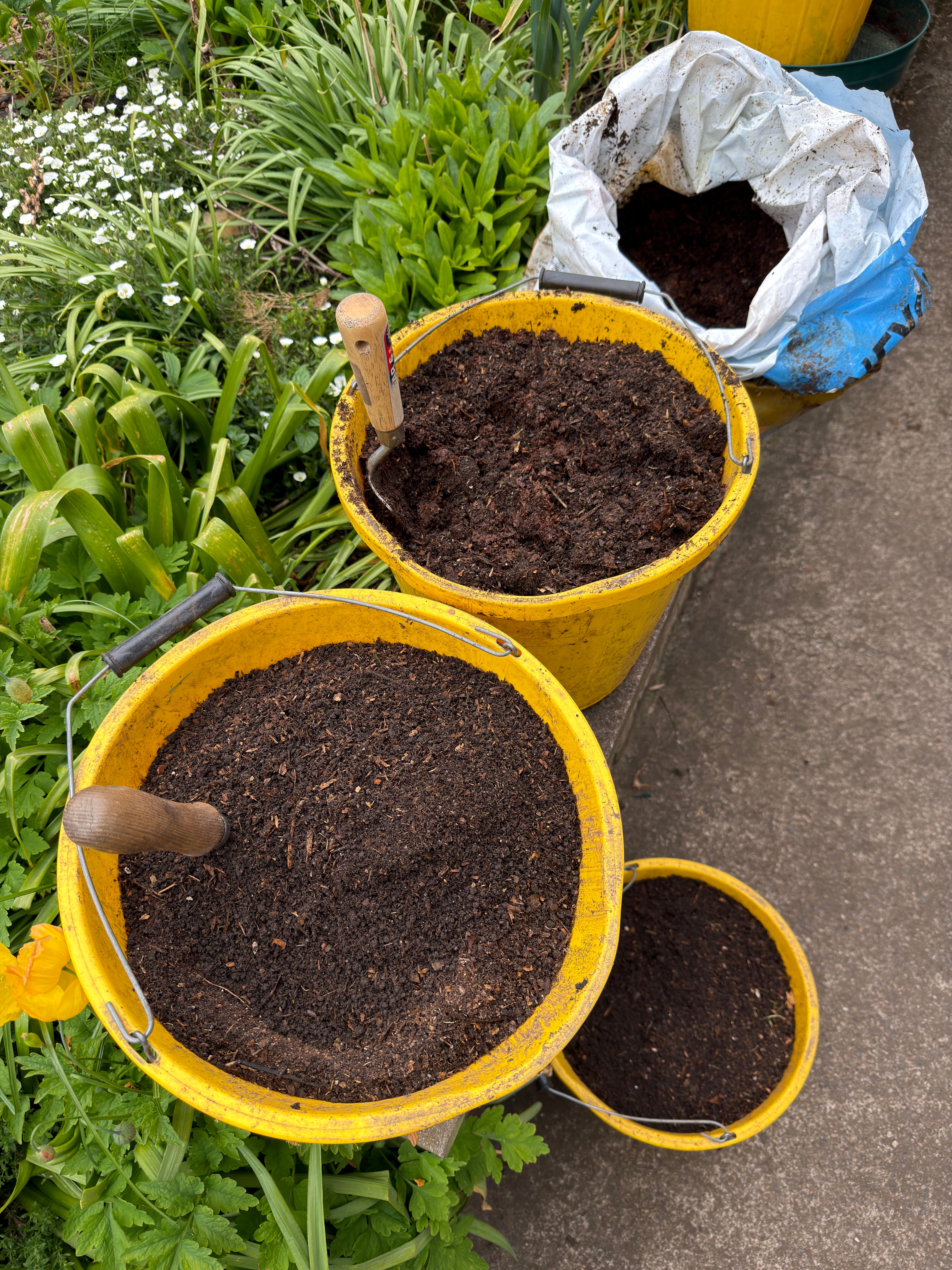
The mayhem of early Spring prepping has died the death. I’ve sifted three more buckets of homemade compost to see me through, mixed one with 3-year-old manure for the outdoor tomatoes and dug out the sunbeds. A little weeding and attention to watering, plus a few trays of French beans and herbs to sow, and I’m done. It’s time for us to enjoy the fruits of our labour; and it won’t be long. And that is what my next article, “First Dibs” will address in June. It’s nothing short of amazing, how quickly foodstuff grows, at this time of the year, or how flavoursome it is. Once again, after a few short weeks in May, called the ‘hungry gap’, we’ll be eating like kings.
This year’s life-changing innovation:
No exaggeration; this tiny detail, housed by my hosepipe has completely changed my garden for the better. A small redundant children’s toy-box, on its way to the tip, rescued and filled with soapy water. It’s the perfect size to wash even my largest pots and trays in and it sits in a shady nook between a rhubarb plant, a rose and my pea-cage, where nothing else exists. Everything that needs washing gets washed immediately it is done with. No more piles of dirty pots and trays, stacked around the place, on paths and in-between rows of potatoes, attracting slugs. It’s recycling at its finest and it saves on slug-pellets. Like the physiotherapy incurred by working the soil, I highly recommend it.
Looks as if you are doing a good job in your backyard